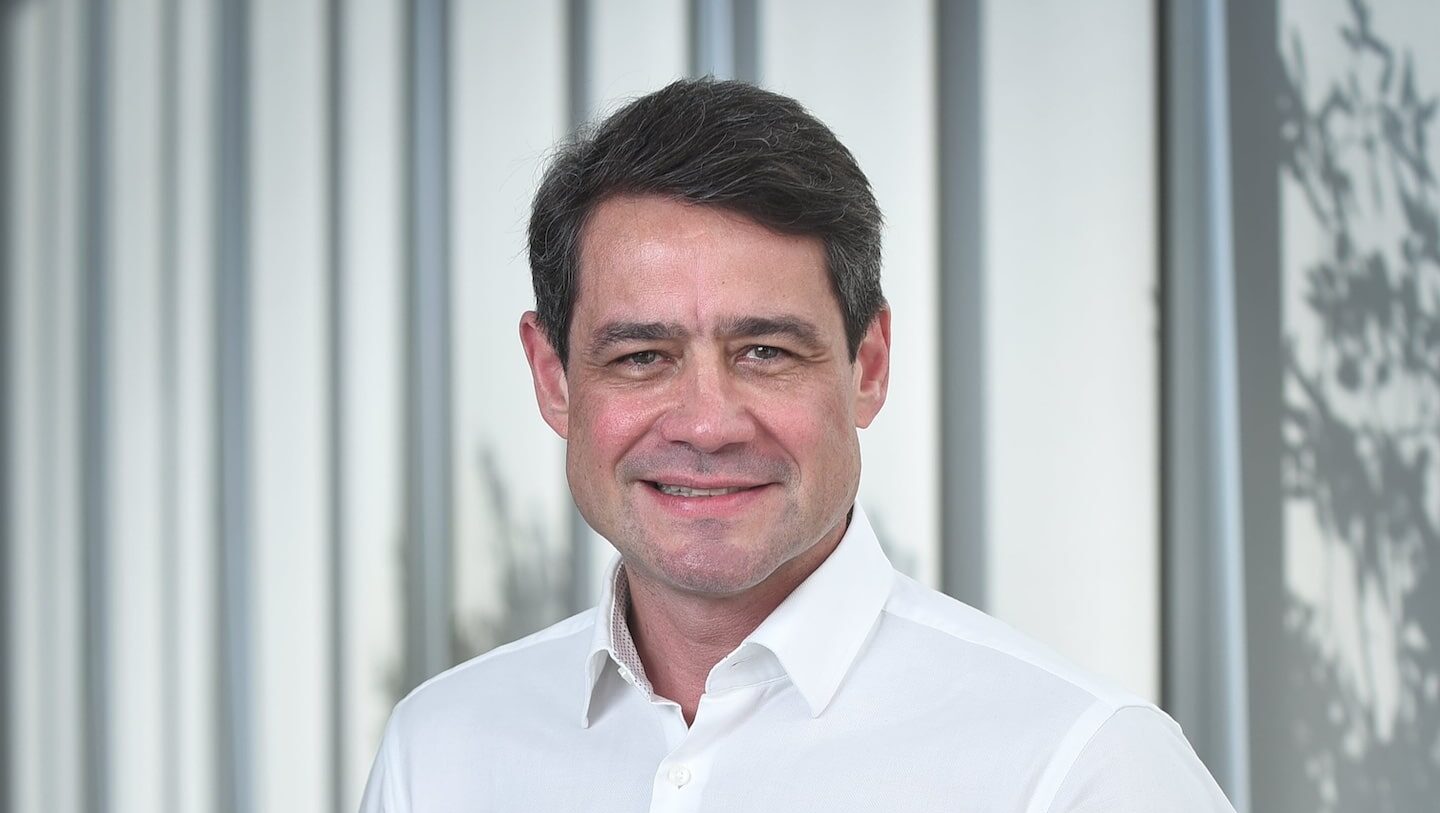
Renato Giarola took over at the end of 2023 as head of Falabella’s supermarket subsidiary. “It had been severely affected,” he acknowledges. He first worked from Peru and moved to Chile in January. He replaced 80% of the management team, eliminated 60% of private-label products, reduced store sizes, lowered prices by 5%, and revamped logistics. Today, the company is reporting positive results.
Renato Giarola has just returned from Europe. Together with other executives, he traveled to England, Portugal, and Spain. “We were inside the operations,” he says. They reviewed the business models of Mercadona, Ocado, and others. He has spent the last two years trying to reverse results that, he admits, had been negative for a decade. “The work has been arduous,” emphasizes the Brazilian executive.
Previously, he worked at companies such as Lojas 1A99, Dia, and Grupo Pão de Açúcar. In December 2023, Giarola assumed the corporate leadership of Tottus, which was based in Peru, where the company also operates the discount format Precio Uno. In January this year, the corporate headquarters moved to Chile. “I was far from the corporate center, where the strength of the ecosystem lies, including technology and logistics,” he says about the move to Chile. He adds: “Because Tottus sells products with lower added value, it is a major redemption channel for F Puntos earned by customers shopping at Falabella or Sodimac, so being closer made it easier to strengthen that connection with the ecosystem”.
His main objective as Corporate Manager was to turn the business around. “Both operations needed adjustments and strategic changes, it was a brand that had been heavily affected,” he emphasizes.
In Chile, Tottus has remained in fourth place in the supermarket sector with approximately 7% market share, well behind Walmart, Cencosud, and SMU. In Peru, the company holds a 33% market share.
The results are now becoming visible. “We are happy because what we defined two years ago is working”. During the first half of the year, the Chilean supermarket subsidiary generated profits of CLP 8.853 billion, compared with CLP 585 million a year earlier. Revenue between January and June increased by 8.2%, and same-store sales rose 7.1%, even though overall sector sales declined.
Surveys of 10,000 Customers
Of its 162 stores, Tottus has 71 in Chile. Initially, the company operated formats ranging from 8,000-square-meter hypermarkets to 1,200-square-meter supermarkets. “The value proposition was weak. We were not cheaper than the market and had too much assortment. We needed to adjust it”.
It took six months from his arrival in 2023 to design a complete transformation. He traveled throughout the region and to England, where the Tesco chain had lost significant market share after the arrival of Lidl and Aldi, “but they turned it around”.
He commissioned 10,000 customer surveys, 5,000 in each country, asking everything from where customers bought their meat to their bread preferences. “The results showed that everyone had a very poor experience, we were off the customer’s radar,” he admits.
The first decision was to focus on the supermarket format. Store sizes were reduced to between 2,500 and 5,000 square meters, focused exclusively on food retail. The company expects to have all stores remodeled next year. In Peru, due to the lower penetration of modern retail channels, hypermarkets remain part of the strategy.
His guiding principle is “the best experience at the lowest price”. In fact, prices have been reduced by 5% over the past two years, “very much in line with Walmart”, and the company expects to continue reducing prices through three levers: price, differentiation, and operational efficiency. Over the last two years, Tottus reduced SG&A expenses by two percentage points, simplified the organization, streamlined decision-making, and reduced headcount.
The management team from four years ago has changed completely, with approximately 80% of managerial positions replaced. “We have hired senior food-retail professionals from Walmart, Cencosud, Carrefour, Pão de Açúcar, and others”. “You can see a winning team, we have 7% market share, but we’re ready to compete,” he stresses.
At one point, the company employed 33 consultants, including former executives from Lidl, Aldi, Sonae Portugal, Carrefour Brazil, Walmart, and Mercadona. To support lower prices, Tottus implemented annual supplier contracts. “Before, everything was negotiated all the time,” he emphasizes.
Initially, convenience purchases were above the market average. “I’m missing a product, I don’t have another option, so I stay with the expensive and poor-quality store,” he explains. Monthly replenishment levels were also low. “That has changed significantly and we are growing strongly in pantry-shopping categories”.
The company also launched a friendliness initiative among store associates, “because it was a tough store”.
200 New References
At Tottus headquarters in downtown Santiago, there is a “laboratory”. It is a kitchen surrounded by tables and chairs. In the middle are different products for everyone to taste, as well as a barbecue area. The company purchases meat from various suppliers and organizes tastings. Any employee can participate.
“Improving assortment is what costs the most, and it is the biggest differentiator,” says Giarola.
Tottus reviewed 100% of its private-label assortment and removed 60% of products due to quality issues. “We cut private-label participation in half,” he says, “and we are only now beginning to relaunch it, with a new architecture”. In cleaning products, the company launched the Expert brand. It also operates MiPet for pet products and plans to introduce a personal care brand.
The company has currently completed about 10% of the process, with approximately 200 new product references launched, out of a total of 2,200.
According to recent surveys, customers now recognize that Tottus has changed. “Non-regular customers have increased” and the company has started its expansion studies. Giarola is expected to present that plan in December.
Its strongest presence is in the Metropolitan Region, where it holds 12% market share with 12 stores, and the objective is to continue growing there as well as in northern Chile. In the south, the chain reaches only as far as Concepción, with relatively few stores. “It is always better to gain concentration than to start with dispersion,” he notes. The objective is to achieve logistics efficiencies.
Previously, Tottus operated one distribution center in Peru and another in Chile. “There was much more inventory in stores, around 35 days in-store, and another 15 in distribution centers,” a model that did not fit the Chilean reality. The company is now centralizing operations: 30% of products representing 50% of sales are held in distribution centers, and it will launch a fresh-products distribution center in Pudahuel and, in 2028, another for dry goods. As a result, 85% of the business will be centralized, “we are going to have a buffer that did not exist before”.
After that, the company will evaluate smaller distribution centers in other regions.
While becoming the market leader is not currently part of the plan, “it is a highly concentrated market, and Tottus stood still for a long time”, the company is evaluating the best way to grow quickly. One of the key growth pillars is e-commerce, where although sales are growing faster than the market, at 33%, penetration remains practically half of the sector average of 13%-14%.
The company is investing in systems. It launched a new app and website and integrated them with distribution centers and stores. “We offer delivery within 120 minutes, we have improved service levels,” says Giarola, “we are evaluating formats, e-commerce is a major focus”. “There is strong pressure on us to grow”.
In Peru, Tottus operates the discount format Precio Uno. Could that format be introduced in Chile? “We have nothing defined,” he emphasizes.
The company estimates that within two years its value proposition will be fully competitive, “but we need to begin expansion now”.
“The company is finally regaining confidence. It lost money for ten years, only became profitable last year, and this year will continue in the same direction,” he acknowledges. “People did not believe in Tottus before, now they do”.
Article by El Mercurio.